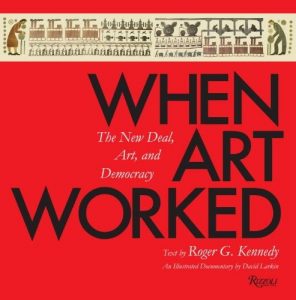
When Art Worked the New Deal Art and Democracy
"The duty of erecting and maintaining certain public works and certain public institutions, which it can never be for the interest of whatever individual, or grouping of individuals, to erect and maintain, because the turn a profit could never repay the expense… although it may frequently do much more than repay it to a great society." – Adam Smith, WEALTH OF NATIONS[1]
"It has been a primal American belief that education is the surest means of bettering society. Moreover, all through the nineteenth century that conventionalities was manifested in public expenditures that made Americans the best-educated people in the world. During the bourgeois era, that trend came to an stop." – Robert Heilbroner and Aaron Vocalizer, THE ECONOMIC TRANSFORMATION OF AMERICA: 1600 TO THE PRESENT [2]
By Stas Margaronis
In When Art Worked, author and historian Roger Kennedy explains how Franklin Roosevelt'south New Bargain deployed taxpayer dollars to combat the unemployment caused by the Great Depression to not only create new jobs and new infrastructure, but also fine art.
Roosevelt, Kennedy writes, decided it was important to fund unemployed artists and back up painting, music, theater, photography, writing and other pursuits across the country.
A Smithsonian Magazine article describes the origins of New Bargain back up for the arts:
"As the Federal Emergency Relief Act, a epitome of the New Deal work-relief programs, began to put a few dollars into the pockets of hungry workers, the question arose whether to include artists amidst the beneficiaries. It wasn't an obvious thing to practise; by definition artists had no "jobs" to lose. But Harry Hopkins, whom President Franklin D. Roosevelt put in charge of work relief, settled the matter, saying, "Hell, they've got to eat just like other people!"
Thus, was born the Public Works of Art Project (PWAP), which in roughly the showtime four months of 1934 hired 3,749 artists and produced 15,663 paintings, murals, prints, crafts and sculptures for authorities buildings effectually the country. The bureaucracy may not have been watching too closely what the artists painted, but it certainly was counting how much and what they were paid: a total of $i,184,000, an average of $75.59 per artwork, pretty adept value fifty-fifty then. The premise of the PWAP was that artists should exist held to the aforementioned standards of product and public value every bit workers wielding shovels in the national parks."[3]
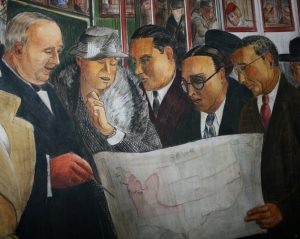
Eleanor Roosevelt, Edward Bruce, and other New Deal officials observe the spread of PWAP projects across the country (detail from "Powell Street," fresco by Lucien Labaudt, Coit Belfry, San Francisco)[4]
In 2020, Covid-nineteen economical dislocations have already generated several stimulus bills including one for $2.three trillion. New bills to support infrastructure spending are imminent. Could support for the arts exist a possibility?
NY TIMES ARTS REPORTER DOUBTS ARTISTS WILL RECEIVE SUBTANTIAL FUNDING
Julia Jacobs, New York Times Arts reporter concluded, "The Virus Won't Revive F.D.R.'south Arts Jobs Programme. Hither'due south Why: The Federal Art Projection, part of Roosevelt'due south sweeping employment program, gave work to thousands of artists, but politics and social club were different then."
She goes on to write:
"There is talk over again in some circles of fashioning additional federal help for artists as the pandemic wreaks havoc on their livelihoods. Some lawmakers, for instance, wanted $4 billion in emergency funding for the arts included in the stimulus package.
"There are going to exist a lot of people out of work who make their living as a musician, people working for community theaters," said Representative Chellie Pingree, a Maine Democrat and leader of the Congressional Arts Caucus, concluding month. "You can't plow your back on them."
Merely few defenders of the arts are optimistic that a plan every bit sprawling and generous as the New Bargain initiative could happen now.
"I'grand not certain you can get Congress to concord on annihilation," said Barbara Bernstein, founder of the New Bargain Art Registry, an online guide to art from that era. "Especially non something as easy to brand fun of as an art program."
For one, President Trump has bandage himself as an arts antagonist, at least when it comes to funding. In each of his budget proposals equally president, he has called for the elimination of the National Endowment for the Arts and the National Endowment for the Humanities.
And he has no shortage of allies, some of whom view the arts every bit elitist and others who say that, however valuable, cultural matters should not be the work of government.
Nikki Haley, the Republican former Un ambassador, reacted with criticism when Congress finalized the $2 trillion emergency assist nib in March and set aside $250 million for the arts, including the N.E.A., the Due north.E.H., and public idiot box and radio — less than 7 percent of what lawmakers like Representative Pingree had pushed for.
"How many more people could take been helped with this money?" she tweeted.
Jacobs goes on to say:
"The mood was different when the New Bargain program passed. Certainly, conservatives of that era viewed some artists as dangerously radical leftists, merely Roosevelt's plan was a pocket-size part of a major initiative that included money for projects like new roads and bridges. Information technology was pushed past a popular president whose party controlled both houses of Congress. And it came at a time when some in the government saw the morale-boosting benefits of creating a truly "American" artistic style, 1 no longer derivative of Europe, said Ms. Bernstein.
During that era, and then many programs disbursed arts funding under a parade of acronyms that even the artists who had benefited couldn't continue the names direct.
The Farm Security Administration, for example, was the unlikely sounding source of projects that produced famous photographs like Dorothea Lange's "Migrant Mother" and Gordon Parks' "American Gothic.""[five]
INFRASTRUCTURE AND Fine art
Nonetheless, Roger Kennedy argues that the role of artists is relevant and of import and perhaps that relevance will resonate in today'southward economic crisis.
In When Fine art Worked, Kennedy describes how programs such as the Works Progress Assistants (WPA), headed past Harry Hopkins, a former social worker, non only created new jobs and economical development but also created an army of artists and new art:
"Public back up for the New Deal was rallied by art that summoned forth pride out of mutual experience. Ofttimes it illuminated common necessities, arousing awareness of suffering people and of suffering nature. Roosevelt in issue said to artists, as he said to many others, "get out amidst the people and make me do it!" Many artists responded by doing what they could with their skills to serve democratic institutions and to take responsibleness for the physical circumstances within which such institutions might flourish.
In the 1960's, Presidents Kennedy and Johnson reanimated the New Deal covenant in language familiar to people who had listened to Roosevelt."[6]
In his book, Kennedy describes the synergy between art and infrastructure in which funding of the arts not only employs unemployed artists to depict, sculpt, paint, and brand music but also explained the urgency of addressing the fundamentals of despair:
"Iconic photographers such equally Walker Evans, Dorothea Lange and Arthur Rothstein captured stirring images of rural poverty for the Subcontract Security Administration – scenes that made the state enlightened of the plight of farmers and migrant workers. The spectacular landscapes of Ansel Adams exemplified the grandeur of America's natural beauty and highlighted the need for wilderness preservation."[7]
Lange's famous photograph of a migrant mother gave a face up to the suffering of millions of Americans during the Depression and help galvanize public back up for New Deal programs through making pictures speak a g words:
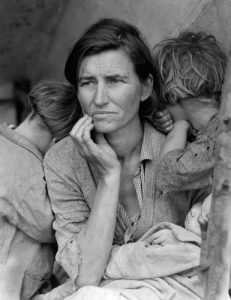
Migrant Mother, Nipomo, California, photograph by Dorothea Lange 1936: Library of Congress, Washington, D.C.[8]
TENNESSEE VALLEY AUTHORITY
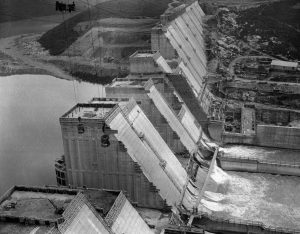
The Tennessee Valley Authority's Norris Dam was nearing completion at the time of this photograph on July 22, 1935: AP Photo[9]
Kennedy describes projects such as the Tennessee Valley Authority, which built dams to provide flood control and ability generation for residents of the impoverished Tennessee Valley.
Projects like TVA supported rural electrification, soil conservation, building roads, bridges and building a world-form economic platform that would propel the United States to victory in World War II.
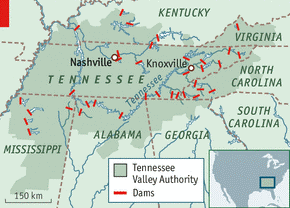
Map: The Economist [x]
Kennedy says these New Deal project had an artistic quality of design in their planning:
"The NRPB (National Resource Planning Lath) survived its own succession of proper name changes and mission redirections… The NRPB planners were in their means important New Bargain artists. Their countdown experiment in ecosystem direction was art achieved across an entire river basin as they worked with the Tennessee Valley Authority (TVA). It evolved into many complex industrial projects, simply to its founders, conservation and taking responsibility through planning were as important as power generation…
The TVA's cluster of existing federal dams and power plants at Muscle Shoals, and the additional engineering marvels produced by it, lit and powered upwardly the valley, while information technology led the way in campaigns for inundation command, soil conservation, reforestation, and disbursed industrialization. In the course of planning, splendid designs were generated and illustrated in drawings that were works of art, and many of the actual structures were works of art as well. Thus, the TVA, like the NRBP, CCC (Noncombatant Conservation Corps), the Erosion Service (later Soil Conservation Service) … and the non-art components of the WPA were presented to the public past artists, just a few of whom were on their payrolls. Most were employed by the WPA arts programs. A smaller simply historic group was commissioned by the Treasury Department, initially through its ain relief program … and after … through its Procurement Partition'southward Section on Fine Arts."[xi]
According to a Social Security Assistants report: "In 1933 the Department of the Interior created what it chosen the National Planning Board (NPB), which was intended to plan public works initiatives for the Depression-era relief projects undertaken as role of the New Deal. In 1939, the federal regime underwent a large reorganization, one upshot of which was to transfer the NPB to the Executive Office of the President, and to rename it the National Resources Planning Lath… The NRPB was a pocket-size executive grouping, headed past the President's uncle Frederic A. Delano, and staffed by a modest group of academic and authorities experts."[12]
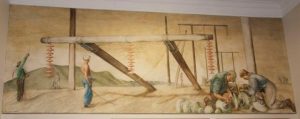
Electrification, Post Office, Lenoir Metropolis, Tennessee, David Rock Martin, 1940 (U.S. Post Part)[thirteen]
On its website, the Tennessee Valley Authorization (TVA) traces its origins to 1933. Signed in 1933, the Tennessee Valley Potency Act created a public corporation "To improve the navigability and to provide for the flood control of the Tennessee River; to provide for reforestation and the proper use of marginal lands in the Tennessee Valley; to provide for the agronomical and industrial development of said valley … and for other purposes."
Below are some landmarks in the TVA development:
The 1930s
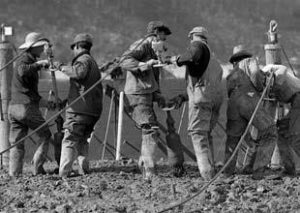
With the state reeling from the Great Depression, President Roosevelt created his "New Deal" to aid America recover. The Tennessee Valley Authorisation was founded to help the hard-hit Tennessee Valley, where it was tasked with improving the quality of life in the region.
The 1940s
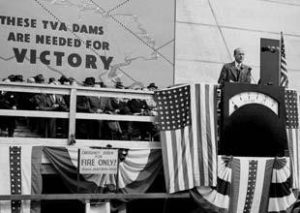
Against the backdrop of Earth War Two, TVA launched one of the largest hydropower construction programs e'er undertaken in the U.s.a..
The 1950s
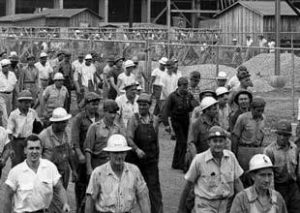
Serving as the nation's largest electricity supplier, TVA benefited from 1959 legislation that made our power system cocky-financing.
The 2000s
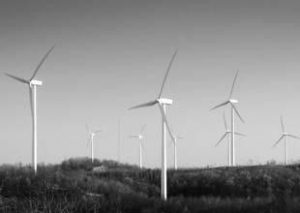
With ability need growing, TVA turned its attention back to make clean nuclear energy, returning an idled reactor to service, and paving the way to terminate structure of another: "Nosotros also launched the outset dark-green power program in the Southeast."[xiv]
HOW NEW Deal Support OF THE ARTS BENEFITED THE NATION
"I think that the Federal authorities today must correspond the needs and wishes of the people more than and not less, and I believe it is important on every level, municipal, state and federal to found a vast cultural art program, because, Joe, our profit system is not capable, every bit I said to cope with it. The artist is the least needed person in our lodge considering no big business organization can exploit him and brand money." Anton Refregier, WPA Mural Painter
The jacket summation of When Fine art Worked: The New Deal, Fine art and Republic says the book "commemorates the achievements of the artists put to work by the government and explores how their art repaired the nation's sense of itself. It also uncovers the fascinating historical back story that inspired Roosevelt to institute programs that rekindled America's ingenuity. Presented within these pages is a tape of this restoration and reshaping of the country…
The creative energy that existed – thanks to a shared sense of purpose to re-energize the country – inverse the landscape, buildings, and culture. Art during the Dandy Depression likewise had an impact on public policy, for instance, bringing attention to the importance of righting social inequalities and preserving and creating national parks.
Amidst these projects, over ane grand post offices were transformed through the landscape program of the Works Progress Administration. These elaborate post office murals celebrated local history promoted community pride…
The story of how fine art works for democracy is a big ane, and is told through the 450 remarkable and varied images chosen past David Larkin and a compelling narrative past historian Roger G. Kennedy. This stunning and comprehensive volume and embodies the vast scope and soaring ethics of that era."[15]
ANTON REFREGIER: WPA MURALIST & INFRASTRUCTURE CHAMPION
"I was born in Moscow, Russia in 1905. I went to Paris at the historic period of fifteen and there I had the great fortune of being taken on as an apprentice by a very dandy man by the proper noun of Vassilief. This was a remarkable human who, I recall in a manner, conditioned my whole life. He was a human being of the Renaissance. I recall his studio … The task was being an apprentice. I had to sweep the floor, go along the clay wet. I remember doing a papier mache throne for Boris Godunov. I remember casting sections of the human body for Paris Hospitals. I remember ushering in and out his mistresses…" – Anton Refregier
One of the famous post office murals painters was Anton Refregier who painted "History of San Francisco" a fix of murals at the Rincon Mail Office in San Francisco.
Refregier is non featured in Kennedy'due south book, but he was a WPA artist who portrayed the synergy between art and infrastructure too as championing the rights of labor, women and African-Americans.
SF Mural Arts is an online resource "for those who are passionate about art and intrigued by the murals of San Francisco. The website highlights a collection of murals visible on urban center streets and those that are tucked away in the interiors of city buildings."
On its website are a consummate collection of reproductions of the Refregier murals painted at the Rincon Post Part.[16]
Anton Refregier was born in Moscow and moved with his family to Paris and eventually emigrated to the Usa in 1920. He earned a scholarship to the Rhode Island School of Design, and upon graduation moved to New York City in 1925 finding piece of work for interior decorators. Working for the WPA/FPA from 1935-1940, provided Refregier, like other artists during the Keen Depression, commissions and an hourly wage.
His most famous work was the murals that compose "History of San Francisco" painted at the Rincon Post Office in San Francisco. The mural was commissioned in 1941, but was halted due to the onset of World War II and not resumed until 1946 and completed in 1948: " Refregier broke from WPA tradition of painting images of difficult work catastrophe economic hardships, and instead cull to include in his landscape the more controversial events from California history, such as anti-Chinese riots and the waterfront strike of 1934. The piece of work became the most controversial of all the WPA art projects, sparking national debate simply the work has since been protected as a National Historical Place."[17]
LABOR ADVOCATE: 1934 LONGSHORE STRIKE
The 1934 longshore strike concluded with longshore workers winning decent wages and working conditions loading and unloading ships on the U.S. Pacific Declension. The successful strike represented one of several primal labor victories during the 1930s that established the correct of workers to exist represented by unions and savour adept wages and working weather. With the onset of Earth State of war Ii union recognition of workers by the Roosevelt administration created new well-paying jobs in state of war-related industries, such as shipbuilding (see beneath) that pulled the United states of america out of the Smashing Depression.
The Waterfront
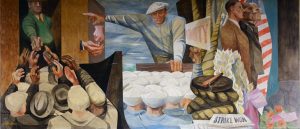
Console #24. This controversial panel depicts events surrounding the San Francisco dock strike of 1934. On the left, a shakedown operator demands bribes in exchange for longshoremen jobs. The heart shows labor organizer Harry Bridges addressing dock workers. The correct third refers to what is known equally Bloody Thursday, July 5, 1934, when employers battled strikers to open docks. Two longshoremen died and many on both sides were injured. (text from a plaque on the wall)[18]
BUILDING THE GOLDEN GATE Span
In constructing the Golden Gate Bridge and the San Francisco Bay Bridge, Charles Seim, chief of price bridges operations back up with the California Department of Transportation wrote:
"These bridges are a tribute to the engineers who planned, analyzed, and designed them, but also a tribute to the daring men who daily risked their lives in the struggle of building the bridges confronting the elements. These men were doing an exciting job and took danger in footstep. Taking risks was their contribution to the building of the bridges and unfortunately a few contributed their very lives.
Today, the visitor or the commuter should view these wonderful structures not only as monuments to themselves but equally monuments to those men whose courage enabled them to plan and cock these bridges to serve society ever after."[19]
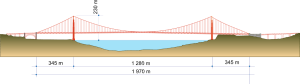
Analogy Source[20]
In keeping with the synergy of infrastructure and art, another landscape celebrates the structure of the Golden Gate Bridge besides as the workers and its chief engineer Joseph Strauss:
"TheGolden Gate Bridge is a suspension bridge spanning the Gold Gate, the one-mile-wide (one.6 km) strait connecting San Francisco Bay and the Pacific Ocean. The structure links the U.Southward. metropolis of San Francisco, California—the northern tip of the San Francisco Peninsula—to Marin County, carrying both U.S. Route 101 and California State Route one across the strait. The bridge is one of the most internationally recognized symbols of San Francisco, California, and the The states. It was initially designed past engineer Joseph Strauss in 1917. It has been alleged 1 of the Wonders of the Modern World by the American Society of Civil Engineers. At the time of its opening in 1937, it was both the longest and the tallest suspension bridge in the earth, with a main span of 4,200 feet (one,280 yard) and a total height of 746 feet (227 m)."[21]
Edifice the Gold Gate
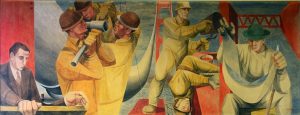
Panel #25. Construction of the Golden Gate Bridge was begun in 1933 and completed in 1937. At that time, the 4,200-foot bridge was the longest in the world. The towers are 746 feet high; ship clearance underneath the roadway is 220 anxiety. The chief engineer, Joseph Strauss, designed and built over 400 bridges during his lifetime. The Gilded Gate Span is considered his masterpiece. (text from a plaque on the wall)[22]
MASS-PRODUCING Liberty SHIPS DURING Earth War Two
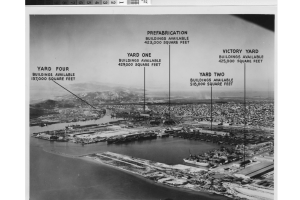
Richmond Public Library[23]
The third panel, SHIPYARDS DURING THE State of war reflects revolutionary changes unleashed past the New Deal, in new technology, mass-production of ships, women'south rights and the employment of African-Americans. The panel celebrates the mass-production of Liberty Ships directed by industrialist Henry Kaiser, who is also the founder of the Kaiser Healthcare arrangement. In the mural, the artist shows us:
1) The welding torches depicted in the landscape reflected the use of welding as a new technology to build ships. Riveting had been the traditional means of constructing steel hulls.
ii) Welding facilitated the mass-production of Freedom ships.
3) The mass-production of Freedom ships was a successful federal programme of the Roosevelt administration financed and coordinated past the U.S. Maritime Commission.
four) The mass-product of Freedom ships provided the maritime conveyor belt and supply concatenation that helped the Usa win wars in Europe and Asia.
5) The two welders depicted on the left side of the mural are both women showing their importance in wartime structure.
iv) An boosted change to the traditional white-only workforce environment is the fact that 1 of the women welders is African-American. Backed by the Roosevelt administration, Kaiser'due south shipyards and other wartime industries supported the hiring of women and minorities:
"Kaiser and his workers applied mass assembly line techniques to building the ships. This production line technique, bringing pre-made parts together, moving them into place with huge cranes and having them welded together by "Rosies" (really "Wendy the Welders" here in the shipyards), allowed unskilled laborers to do repetitive jobs requiring relatively picayune grooming to accomplish. This sped up structure, allowed more workers to be mobilized, and opened jobs to women and minorities." [24]
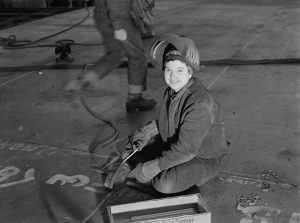
Photograph By Ann Rosener, U.S. Office of War Information
A former female welder at the Kaiser shipyard, who after became a dentist, said that women proved to be good welders, considering they tended to be more than detailed-oriented and precise than their male person colleagues. She said women were also able to weld in narrow confines such as the ballast tanks. Finally, she said, women were more willing to practice the dirty jobs.[26]
Shipyards During the War
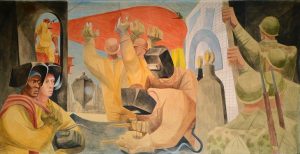
Panel #26. With the onset of World War II, shipbuilding, a major California manufacture during World State of war I, became important once again. By 1943, the shipyards employed over 282,000 workers, upward from 4,000 in 1939. Henry J. Kaiser was the near of import of the World War Ii shipbuilders. His assembly line operations produced a Liberty ship in 25 days and a freighter every 10 hours. The two workers pictured in the lower left corner of the panel are women. (text from a plaque on the wall)[27]
ORAL HISTORY: THE LEGACY OF PUBLIC Support FOR ARTS & WPA
As office of the Smithsonian Museum's Archives of American Art series, Anton Refregier, was interviewed by Joseph Trovato in November 1964. The artist gives directly testimony to his motives, inspirations and the importance of the WPA and Roosevelt'southward New Deal:[28]
- "I consider was one of the most wonderful periods of our lives, the 3Os, in spite of the fact that it was wonderful in a peculiar way. After the Wall Street crash, with the groovy suffering of the people, the people had to be provided for. Past the wisdom of one of the greatest Presidents nosotros e'er had, Roosevelt, it'southward common knowledge the WPA, a relief plan, was established, for, as Roosevelt, said, it was necessary to protect the skills of the American people. With that point of view, it was soon found that the first people who were starving at that fourth dimension, of form, were the artists and the people in the arts. Then quickly, nosotros were all put to work. The best people came to Washington at that time. Roosevelt was a kind of a magnet that attracted the best minds, which, of class, I cannot say for Washington in postwar catamenia, although I think that Kennedy was that kind of a person, too. He could, if he had lived, probably washed a little bit more for the spiritual and cultural life of our people. The wonderful thing virtually that menses, Joe to me-was the human quality, the humanist attitude that we had, and I think it was very definitely the consequence of discovering that the artist was not autonomously from the people. Starting time of all, we were all in the aforementioned boat. Nosotros all had to go thru a relief program. We all had to exist investigated. In order that the investigator would come to your business firm, open the icebox and make certain in that location was nothing inside. Then you were all right."
- " Every bit a matter of fact, I recall the lesson of our period of the WPA fine art programme and the Section of Fine Arts (referred by Kennedy above-ed note), which I would like to talk to you nigh later on, is something that I talk time and fourth dimension again everywhere I go. I spoke of it in England and Sweden and France, I spoke of it in Moscow, and Budapest, and Berlin. I experience it is something we should be very proud of, and certainly it is a pattern to remember I would like to see our regime returning to this responsibility. Yous see, I don t go along with all this business organisation of states' rights and all this. I think that the Federal regime today must represent the needs and wishes of the people more and not less, and I believe it is important on every level, municipal, state and federal to constitute a vast cultural fine art program, because, Joe, our profit system is not capable, as I said to cope with information technology. The artist is the least needed person in our gild because no large business tin can exploit him and brand money."
- " And I remember at that time the excitement of knowing that while nosotros were here working in New York and doing some pretty damned adept stuff, in that location was a swell grouping of artists in Chicago and in St. Louis and in San Francisco and in Los Angeles, and every calendar month or two a new work would come up which would claiming everybody, would excite everybody. I remember when I first met Philip Guston, who had just arrived from Los Angeles. We did not know his work, just when I saw Phil's photographs, especially the mural he did with Kadish for a worker's school in Los Angeles, I was excited. Every time you run into adept work something happens to y'all; you are on a spot."
- "Bobby Dylan, who lives here in Woodstock, can make a record and it may sell probably a million copies. Well, this is groovy for Dylan but information technology's even greater for the American people. They can have his songs in their homes. But the important thing is it's merely possible because the big manufacturers can make great profit out of their original investment. This does not utilise to painting and sculpture; it does not use to graphic arts; it does non utilize to a trip the light fantastic toe; it does non apply to the bulk of composers; it certainly does not employ to poets. Therefore in order that the artist can serve the cultural needs of the people, and I like to use this sentence, I like to use that kind of phrase, I believe it is necessary and essential not to lose the great talent and that is why I say it is necessary for a government program. And I am not worried about waste matter considering let's remember that, while we take the great wealth of the Renaissance in some of our museums and throughout the world, remember that for every bully proper noun nosotros take today there must accept been hundreds of other artists who were working, probably not with the aforementioned kind of talent, simply helped to lift the whole schoolhouse to a higher level of performance. I'm non worried about the reactionaries who say that the WPA was boondoggling and there were some bad artists on the projection. We need everyone who commits himself to the position of beingness an creative person and give him a chance and make sure that we don't waste a single possible talent, Who in official circles could have told whether Van Gogh was an artist or not at the fourth dimension when he first started painting."
- "But l remember in the early period of the Project having luncheon ane day with Bruce and Rowan who were administrators of the Section of Fine Arts in Washington and they asked me, and I was rather flattered, who the artists I thought at that particular time should take been considered for commissions. Well I said- "Ben Shahn. ""Oh, no," they said, "No, he'south too modern!" But the important thing is that Ben Shahn did enter competition and won the Washington Social Security Building, did a very distinguished landscape Every time this happened it did, of course, raise the level of the performers of the Section I, myself, as you know, competed for the San Francisco Mail service Office. This was a national competition with 81 artists competing. I was declared the winner, the jury consisted of the previous winners of the previous jobs, Arnold Blanch, Victor Arnautoff, and and so on. And of class, I spent ii and a half years of the happiest part of my life working on that great Federal programme, Section of Fine Arts. It is there for everyone to see, and this is the way mural painting should function."
Indelible LEGACY OF THE ARTS
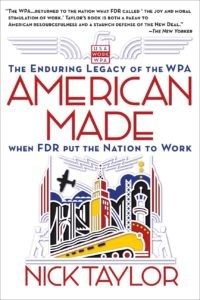
In American Made: When FDR Put The Nation To Work, author Nick Taylor records that one enduring aspect of the WPA was its back up for artists and the arts and especially murals that can notwithstanding exist seen in post offices and public buildings.
The WPA provided federal support for the arts that created jobs for artists and a short menstruum of artistic creativity. Hopkins had argued that unemployed painters, writers, actors, and musicians were just every bit qualified for employment support as whatsoever other worker:
- The Federal Arts Project employed five,000 mural, easel artists, impress makers, sculptures, poster artists, and art teachers. Bourgeois press and politicians criticized this equally a giant waste product of public money. Nevertheless, i example is the indelible presence of murals in postal service offices and other public buildings. This is a tribute to creativity and a celebration of U.S. history by its diverse contributors.[29]
- Another aspect of the Federal Art Project was the deployment of researchers, artists, and photographers who worked at unearthing art and artifacts showing how Americans lived from the 18thursdaycentury onwards. [30]
- The Federal Writers Project created travel guides of states in the United States that not only provided information well-nigh tourism only also about state and local history. Some guides have been re-published and provide an historical document about what life was similar in various states during the 1930s.[31]
Taylor summarizes these accomplishments as follows:
"The accomplishments of the WPA came to be measured in statistics: 650,000 miles of roads, 78,000 bridges, 125,000 civilian and military buildings, 800 airports built, improved or enlarged, 700 miles of drome runways. Information technology served nigh 900 million hot lunches to schoolhouse children and operated 1,500 plant nursery schools. It presented 225,000 concerts to audiences totaling 150 million, performed plays, vaudeville acts, puppet shows, and circuses earlier 30 million people, and produced virtually 475,000 works of art and at least 276 full-length books and 701 pamphlets. Such numbers convey virtually no affect by themselves. They are silent on the transformation of the infrastructure that occurred, the modernizing of the country, the malnutrition defeated and educational prospects gained, the new horizons opened.'[32]
FOOTNOTES
[1] Quoted by Robert Heilbroner and Aaron Vocalist, THE ECONOMIC TRANSFORMATION OF AMERICA: 1600 TO THE Present (1994), p.349
[2] Ibid.
[3] https://world wide web.smithsonianmag.com/arts-civilisation/1934-the-art-of-the-new-deal-132242698/
[4] https://www.newdealartregistry.org/Home.html
[5] https://www.nytimes.com/2020/04/22/arts/new-deal-arts-coronavirus.html?searchResultPosition=1
[6] Roger G. Kennedy, When Art Worked: The New Deal, Art, and Democracy (2009), p.25
[7] Kennedy, jacket encompass
[viii] https://www.britannica.com/biography/Dorothea-Lange
[9] https://www.politico.com/story/2017/05/eighteen/tennessee-valley-say-so-created-may-18-1933-238325
[10]https://www.google.com/search?q=tennessee+valley+authority&safe=off&sxsrf=ALeKk00dnNPViM6ZU257qYN9E-Qq36YTRA:1587837816492&source=lnms&tbm=isch&sa=Ten&ved=2ahUKEwjI94zolITpAhVaPn0KHW4DBmoQ_AUoAnoECCAQBA&biw=844&bih=401#imgrc=WAcTZ3xKW5FtuM
[11] Kennedy, pp 24-25
[12] https://www.ssa.gov/history/reports/NRPB/NRPBreport.html
[13] Kennedy, pp ninety-91
[14] https://www.tva.com/about-tva/our-history
[15] Kennedy, jacket cover
[16] http://www.sfmuralarts.com/ Please see the murals here: http://www.sfmuralarts.com/find/1.html and : http://www.sfmuralarts.com/find/ii.html
[17] https://artmuseum.arizona.edu/artwrite/anton-refregier
[18] http://www.sfmuralarts.com/mural/641.html
[nineteen] Richard Dillion, Thomas Moulin, Don DeNevi, Loftier Steel: Building the Bridges Beyond San Francisco Bay (1978), p.1
[20] https://en.wikipedia.org/wiki/Golden_Gate_Bridge#/media/File:Golden-Gate-Bridge.svg: By Roulex 45 – Own work, CC BY-SA 3.0, https://eatables.wikimedia.org/west/index.php?curid=4216116
[21] https://en.wikipedia.org/wiki/Golden_Gate_Bridge
[22] http://www.sfmuralarts.com/mural/640.html
[23] https://oac.cdlib.org/ark:/13030/kt667nd21p/?make=oac4
[24] https://en.wikipedia.org/wiki/Richmond_Shipyards
[25]https://en.wikipedia.org/wiki/Richmond_Shipyards#/media/File:Wendy_Welder_Richmond_Shipyards.jpg and – This image is available from the United States Library of Congress's Prints and Photographs division under the digital ID fsa.8b08491.
[26] Vallejo, California interview with writer
[27] http://world wide web.sfmuralarts.com/mural/639.html
[28] https://world wide web.aaa.si.edu/collections/interviews/oral-history-interview-anton-refregier-12689#transcript
[29] Nick Taylor, American-Fabricated: When FDR Put The Nation To Work ( 2008) p.270
[30] Taylor, p.278
[31] Taylor, pp 291-292
[32] Taylor, pp 523-524
irbybutillecting44.blogspot.com
Source: https://rbtus.com/infrastructure-artwhen-art-worked-the-new-deal-art-and-democracy-by-roger-kennedy/

Post a Comment for "When Art Worked the New Deal Art and Democracy"